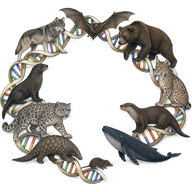
Rapid, population-level microevolution is one of several mechanisms organisms use to keep pace with environmental change, alongside dispersal and phenotypic plasticity. That evolutionary potential is genetically mediated. Its magnitude and speed depend on standing variation and on how labile the life history traits governing growth, reproduction, and maintenance are. Our group combines computational biology, field collections, and cell culture to study these traits in wild, non-model species.
Adaptive and maladaptive potential under rapid environmental change
Population and functional genomics let us quantify the genetic variation that underlies evolutionary potential. Working with State and Federal partners, we sequenced and analyzed whole genomes from 58 Canada lynx (Lynx canadensis) across Maine and eastern Canada. The result is the first quantitative measure of evolutionary potential for this federally protected species (Lama et al. 2026, Molecular Ecology).
The study describes the abundance and distribution of neutral and adaptive variation in four distinct populations. Several life history traits are shaped by strong gene–environment associations in photoreception, circadian entrainment, and temperature regulation. These associations predispose populations with low evolutionary potential, in western Newfoundland and on the Gaspé Peninsula of Quebec, to maladaptation under future climate scenarios. Our assessments have been incorporated into the species’ Endangered Species Act recovery planning.
Our work also aims to close the gap between genomics research and conservation practice. See our policy forum in Science and our chapter in The Codex of the Endangered Species Act.
Mining non-model genomes for the determinants of extreme phenotypes
Allometries describe how life history traits scale with body size and with each other, and they are a central question in evolutionary biology. Using publicly available genomes, we first identify the allometric rules that shape lifespan, brain size, and body size. We then focus on the species that defy those expectations. This approach has highlighted:
- Extreme longevity, cancer resistance, and viral tolerance in bats. Exploratory data-mining has identified protective mechanisms that evolved convergently in bat species whose maximum lifespans can exceed 30 years (Morales et al. 2025; Vazquez et al. 2026).
- Seasonal brain shrinkage and regrowth in the Eurasian common shrew (Sorex araneus), including the adaptive basis of brain size plasticity and chromosomal instability (Thomas et al. 2026) and a newly characterized role for the pancreas of Aselli in immunity (Thomas et al. 2025).
- Desert adaptation in the golden spiny mouse (Acomys russatus), a new direction led by M.S. and Honors students in the lab.
From genomes to cells
Undergraduates run the lab’s cell culture suite. They use primary fibroblast cultures from bats, mice, and humans to test candidate mechanisms experimentally. Guided by graduate students, they establish and maintain cultures and extract RNA and protein for transcriptomic sequencing and western blotting. For example, we compare the little brown bat (Myotis lucifugus), which can live 34 years in the wild, with the similarly sized house mouse, which lives about 4 years in captivity. Two manuscripts in preparation, co-authored by undergraduates, describe mechanisms that enhance mitochondrial maintenance in long-lived species.
Funding
We are grateful for support from the National Science Foundation (Postdoctoral Research Fellowship in Biology), the U.S. Fish & Wildlife Service, the American Federation for Aging Research, the Fulbright Program, the NIH IRACDA program, and Smith College (Blakeslee and Horner Fund endowments).